
Pre-Show Backstage Readiness Template
The moment the house opens, the backstage area transitions from a workspace into a highstakes operational environment where any oversight can lead to a safety incident or a perf...
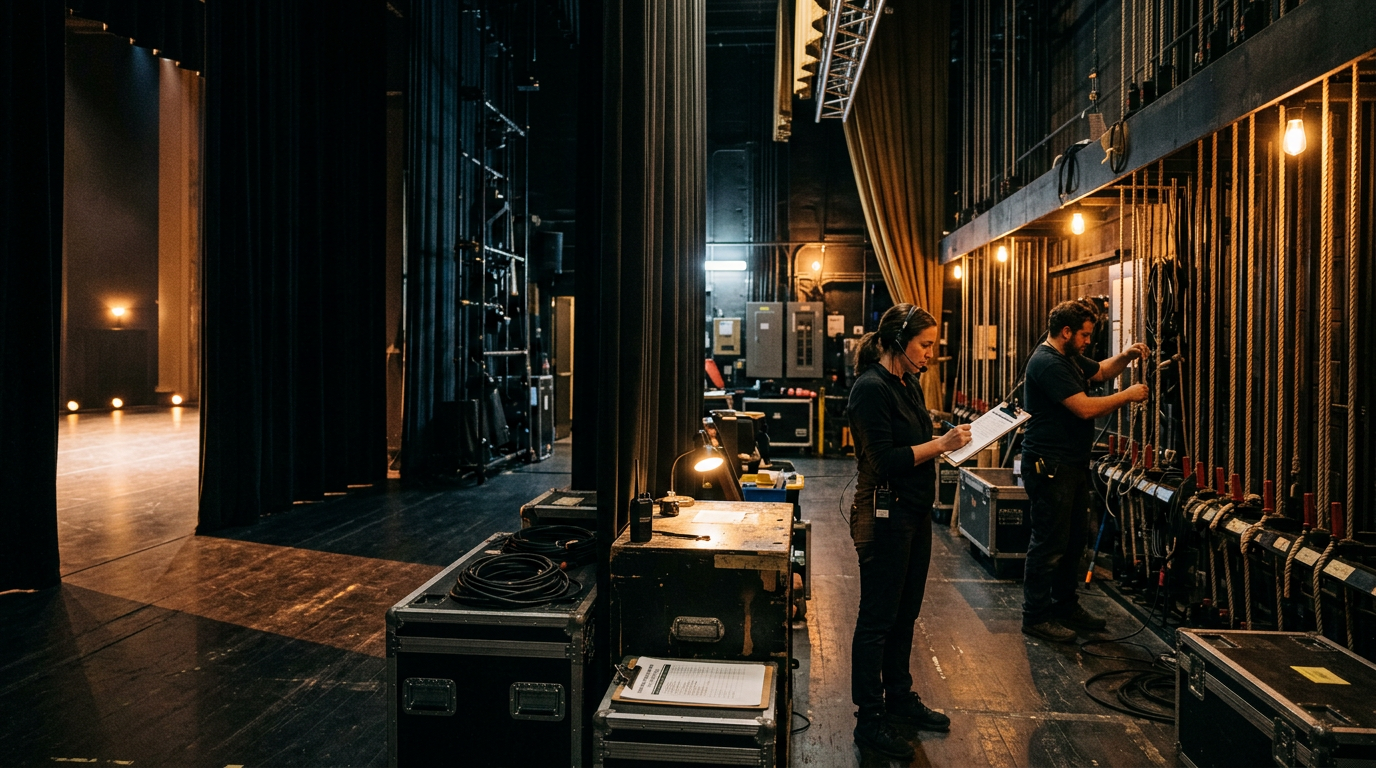
The moment the house opens, the backstage area transitions from a workspace into a high-stakes operational environment where any oversight can lead to a safety incident or a performance failure. This guide provides a definitive framework for backstage readiness, ensuring that stage management and production teams move from "setup" to "show-ready" with mechanical precision.
The Infrastructure of Consistency
Operational excellence backstage is not a result of memory; it is a result of systems. The physical environment must be vetted for safety and functionality before the first performer enters the wings. This begins with clear territorial boundaries and hazard mitigation.
Path of Travel and Sightlines
Stage management must walk the entire backstage perimeter to ensure the "path of travel" is unobstructed. This includes verifying that "blue light" (low-intensity navigation lighting) is functional and that gaff tape markers for entrances/exits are visible in low-light conditions.
- Cable Management: All temporary cable runs across high-traffic areas must be secured with yellow-jacket ramps or gaffed flush to the deck. If a cable bridge creates a trip hazard for a fast change, it must be flagged with glow tape.
- Escape Stairs and Platforms: Check all handrails for stability. If a scenic piece involves an elevated entrance, the "fall-off" protection must be engaged and verified by the deck lead.
Fire and Life Safety
The pre-show period is the only time to confirm that emergency egress remains compliant after the scenic load-in. Ensure that fire extinguishers are visible, charged, and not obstructed by costume racks or prop tables. All fire curtains or pyro-interlock systems must be engaged according to the venue's specific safety protocols.
The Technical Integrity Check
Technical malfunctions often stem from a failure to verify "state" before the show starts. A standard pre-show routine must include a rigorous verification of all motorized and electronic elements.
Automation and Rigging
Automation operators must perform "limit checks" for every moving piece. This involves moving pieces to their full extension to ensure sensors are firing correctly and that no debris has fallen into the tracks.
- Clear the Track: Physically inspect tracks for stray screws or scenic debris.
- Dead-Man Switches: Test all emergency stop (E-Stop) buttons across the deck.
- Communication Loop: Verify that the automation operator has a clear visual or camera feed of the entire travel path.
Audio and Comms
The most common point of failure in live entertainment is the communication system. A "comms check" is not just about hearing a voice; it is about verifying the integrity of the signal across all departments. Conduct a "rolling check" where every station (Fly Rail, Deck Left, Deck Right, Spotlight, Booth) confirms they can send and receive.
For wireless assets, use a printable backstage readiness checklist to log battery percentages and frequency stability for all RF mics and IFBs at the 60-minute mark.
Prop and Scenic Preset Protocols
A "near-miss" in scenery placement can derail a performance. The preset must be binary: an item is either in its marks or it is not. There is no "close enough" in high-speed entertainment operations.
The "Double-Blind" Prop Check
To eliminate human error, implement a double-blind check system. The props master or deck crew performs the initial preset according to the plot. A stage manager then performs a secondary "walk-through" to verify the preset independently.
- Hand Props: Verify that consumables (food, letters that get torn, etc.) are replaced and that electronic props (flashlights, candles) have fresh batteries.
- Weaponry: If the production involves stage weaponry, these must be locked in a secure cabinet until the "Ready" call. They should be handed directly to the actor by the designated weapons handler and returned immediately after the scene.
Wing Management
Clutter in the wings is a primary cause of backstage accidents. Define specific "Dead Zones" where no equipment or personnel may stand. Ensure that quick-change booths are stocked with the necessary tools (flashlights, safety pins, water) and that the flooring in these areas is clean to prevent costume damage.
Performer and Crew Accountability
Managing people is as critical as managing gear. The transition from "Half-Hour" to "Places" requires a strict protocol for personnel tracking.
The Check-In System
The Company Manager or Stage Manager must have a visual or physical check-in system for every performer and essential crew member. Relying on "I think they’re here" is an operational risk.
- The Sign-In Sheet: This remains the industry standard. It should be located at the Stage Door or a centralized call-board.
- The "Half-Hour" Sweep: At 30 minutes to curtain, a designated staff member should do a physical sweep of dressing rooms. This is the moment to identify if a cover or swing needs to be prepped due to an absence.
Access Control
Security during the pre-show window is paramount. Review your backstage access best practices to ensure that only "essential-to-mission" personnel are in the wings. High-traffic areas should be restricted to performers and deck crew once the house is open. VIP guests or non-essential production staff should be cleared from the backstage area no later than the "20-minute" call.
Standardized Countdown and Calling
The final 30 minutes should follow a rigid timeline that never fluctuates, regardless of how many times the show has run. This creates a psychological "readiness state" for the cast and crew.
The Sequence of Calls
- 30 Minutes (Half-Hour): The house is open. All backstage "work" (drilling, painting, major repairs) must cease. Background music or house feeds are live.
- 15 Minutes: All performers should be in the building and moving toward wardrobe/makeup.
- 5 Minutes (Places): Performers move to their initial entrance positions. The Deck Lead confirms "Deck Clear" to the Stage Manager.
- 2 Minutes: The Stage Manager confirms all departments are "Standing By."
Decision Rules for "Hold" Situations
Before the show starts, the Stage Manager and Front of House (FOH) Manager must agree on the criteria for a "Start Hold."
- Safety Hold: Guaranteed hold if a life-safety element (fire curtain, harness, pyro) is non-functional.
- Operational Hold: Hold for a technical failure that prevents the show from progressing beyond the first 5 minutes.
- Front of House Hold: Only utilized for massive transit delays or security breaches at the entrance.
If a hold exceeds 10 minutes, the Company Manager must be prepared to enact a "Performer Reset" protocol to ensure actors stay warm and focused.
The Post-Check Handoff
The readiness process concludes when the Stage Manager receives "Green" status from all department heads. This is often referred to as the "Handoff."
- Lighting/Video: Confirms all dimmers are active and projectors are dowsed/ready.
- Deck/Carpentry: Confirms all scenic pieces are "on marks" and the deck is clear.
- Wardrobe: Confirms all "Quick Changes" are set and performers are dressed.
Once these confirmations are logged, the Stage Manager assumes total operational control of the deck. This clear line of authority prevents conflicting instructions during the performance.
Maintaining the Standard
The greatest threat to backstage readiness is "normalcy bias"—the belief that because nothing went wrong yesterday, nothing will go wrong today. High-performance operations treat every pre-show as if it were Opening Night. Using standardized templates and checklists ensures that even under the pressure of a tour or a complex residency, the baseline of safety and quality remains uncompromised.
Where Rox Teddy Fits
Rox Teddy provides the operational oversight and specialized staffing needed to execute these readiness protocols on a global scale. Our team integrates directly with your production to ensure that backstage workflows are optimized for both safety and artistic consistency.
By implementing these rigorous pre-show standards, production leaders can move from reactive troubleshooting to proactive management, ensuring a seamless experience for the audience and a safe environment for the company.