
Printable Backstage Readiness Checklist
A single missed detail backstage can derail a multimillion dollar production, leading to safety hazards or avoidable performance pauses. This comprehensive guide provides a high...
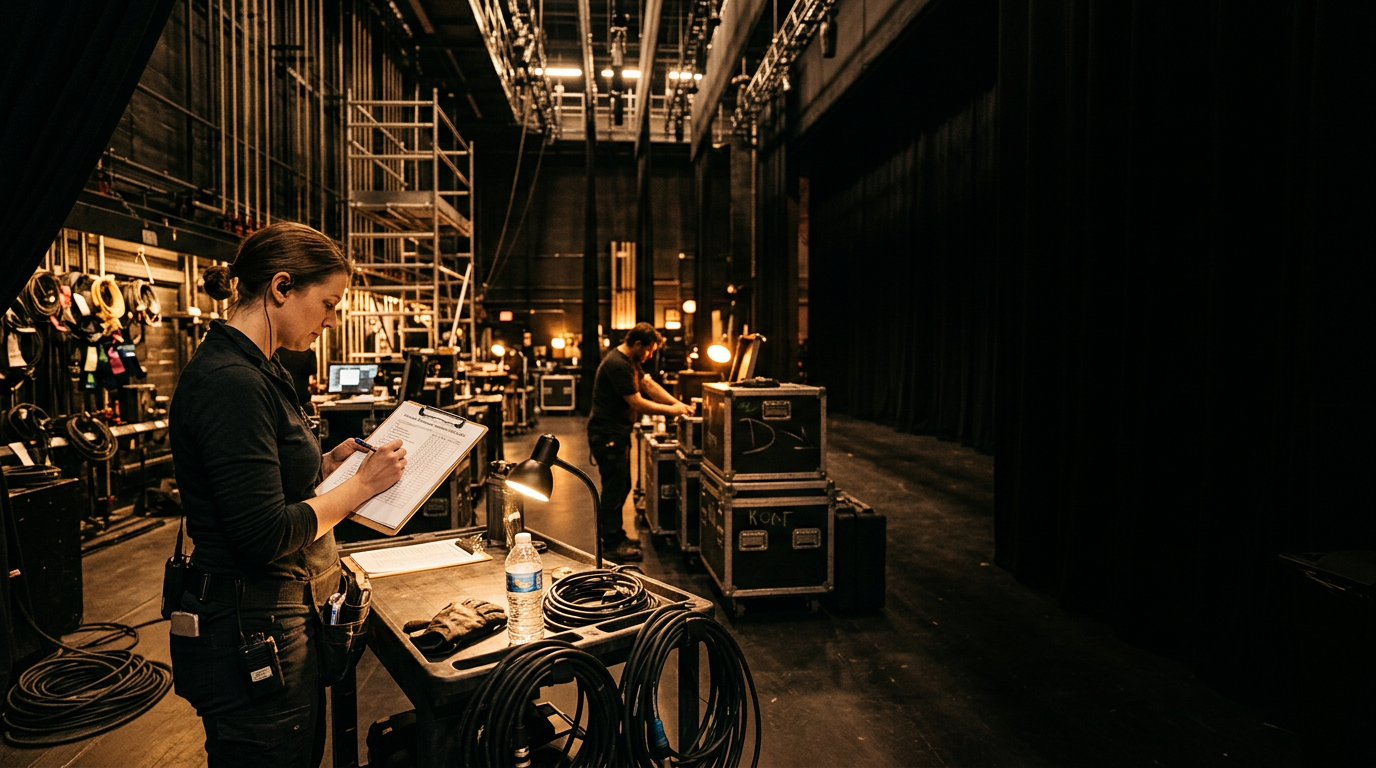
A single missed detail backstage can derail a multi-million dollar production, leading to safety hazards or avoidable performance pauses. This comprehensive guide provides a high-stakes framework for verifying every technical, safety, and logistical variable before the house opens. Use this checklist and the underlying template to standardize your pre-show routine and ensure a professional, consistent environment for your company.
The Physical Stage and Deck Readiness
The stage floor is the most basic yet critical component of backstage safety. Debris, moisture, or misplaced hardware can cause catastrophic injury to performers or damage to moving stage machinery.
Surface Verification
Standard "sweeping and mopping" is insufficient for professional entertainment. Follow these specific decision rules for the deck:
- The Tape Test: Inspect every seam of Marley or vinyl flooring. If tape shows curling or "bubbling," it must be replaced immediately. Humidity changes often cause tape to lift between soundcheck and showtime.
- The Friction Check: Performers relying on specific traction (aerialists, dancers, or acrobats) must have a deck that is neither too slick nor too tacky. Use only approved cleaners; never use household detergents that leave a wax residue.
- Protrusion Audit: Run a gloved hand or a flat-edge tool over areas where trap doors, lifts, or stage screws are located. If you feel a catch, it will trip a performer in the dark.
Hazard Lighting and Marking
Dark changes require precise navigation. Verify that all "glow tape" or LED photoluminescent markers are sufficiently charged. If the stage has been dark for several hours, use a flash-charge (strong work lights) for 15 minutes to reset the glow. Check that low-profile blue running lights are operational and do not bleed onto the stage during blackout cues.
Automation and Rigging Verification
Technical failures in the fly system or automation often stem from a lack of pre-show cycling. You cannot assume a system that worked at the end of last night’s show will work tonight.
Weight and Tension Checks
Verify that all counterweight sets are locked and the "rope locks" are engaged with safety rings in place. If using an automated fly system, check the tension on all lines. Temperature shifts in the theater can cause cables to expand or contract, potentially throwing off "dead" positions (the exact height where a piece of scenery stops).
The "Full Range" Test
Every piece of automated scenery must be cycled through its full range of motion before the house opens.
- Clear the Path: Ensure no props or trunks have been parked in the "travel zone" of a moving piece.
- Observer Placement: Station a technician with a radio at the point of greatest risk (e.g., where a piece of scenery nears the proscenium or the deck).
- Emergency Stop (E-Stop) Check: Perform a daily verification that the primary E-stops are functional and that the operator can see the entire path of travel.
Communication and Cueing Systems
The nervous system of a production is its communication network. A failure here results in missed cues and dangerous "blind" operations.
Headset and Radio Protocols
Do not wait for the "half-hour" call to check comms.
- Battery Management: Every wireless belt pack must start the show with a fresh set of batteries or a 100% lithium charge. Do not "ride out" a 20% battery from soundcheck.
- Sidetone and Mic Check: Every station (Lighting, Sound, Flys, Deck) must confirm two-way communication. If a headset has "crackle" in the line, replace the cable immediately; audio interference often worsens once the house fills with cell phone signals.
- Paging Systems: Test the backstage paging system (the "God Mic") to ensure performers in dressing rooms and Green Rooms can hear calls clearly.
Video Monitor Validation
Stage management relies on infrared and "conductor" cameras. Verify that the infrared (IR) emitters are functioning; without them, the stage manager is blind during blackouts. If the show uses a conductor cam, check for latency. Even a half-second delay in video can cause the orchestra and vocalists to drift out of sync.
Prop and Wardrobe Staging
Backstage space is usually at a premium, making "prop flow" essential. Every item must have a designated home, often marked with white tape and labeled.
The Preset Audit
Using the underlying template, the props master and deck crew must physically touch every prop. Looking at an item from across the room is not a check.
- Consumables: Verify that any food, drink, or "breakaway" items (like sugar glass) are prepared and positioned.
- Safety Props: Inspect stage weapons. Ensure firearms are cleared/plugged according to local laws and that blades are blunted.
- Prop Power: If a prop has an internal light or motor, test the trigger and the battery level.
Wardrobe and Quick Change Setup
Quick change booths must be clear of obstructions.
- Lighting: Check that the clip-lights in the quick-change booth are functional.
- Tools: Ensure "emergency kits" (safety pins, sewing kits, wardrobe tape, and pliers for stuck zippers) are inside every booth, not just in the basement wardrobe room.
- Presettings: Verify that shoes are unzipped and positioned for the performer to step into them instantly.
Safety and Emergency Compliance
In an emergency, the backstage team is the "first responder" for the cast and audience. Operational readiness includes verifying that safety paths are clear and equipment is accessible.
Fire and Egress Paths
Touring shows often "creep" into exit paths with road cases.
- The 36-Inch Rule: Maintain at least 36 inches of clear path to every fire exit.
- Fire Curtain Path: Ensure the "smoke pocket" (the area where the fire curtain hits the deck) is completely clear. One stray chair can prevent the fire curtain from sealing, which is a violation of life-safety codes.
- Extinguishers: Verify that all extinguishers are in their designated spots and that the pressure gauges are in the "green" zone.
Performer Wellness Stations
"Readiness" also applies to the human element. Backstage areas should be stocked with:
- Fresh water at both Stage Left and Stage Right.
- First aid kits containing ice packs (instant-chem or crushed ice), bandages, and antiseptic.
- An Automated External Defibrillator (AED) that is clearly marked and accessible to both the crew and the front-of-house staff.
The Final Sweep: The House Open Decision
The transition from "Backstage Prep" to "House Open" is the most vulnerable time for a production. Noise travels easily from the stage to the seating area.
Strike the Work Environment
Once the technical checks are complete, the "work" environment must be converted into a "performance" environment.
- Tool Check: Ensure no wrenches, screwdrivers, or rolls of tape are left on the stage or on top of high scenery where they could fall.
- Ghosting: Ensure no work lights are left on that might spill light into the auditorium during the opening sequence.
- Radio Silence: Switch all non-essential personnel to a "listen-only" mode or move conversations to a secondary channel to keep the primary line clear for the Stage Manager.
The Verification Loop
The Stage Manager should receive a "clear" from every department head—Lighting, Sound, Props, Wardrobe, and Carpentry—before authorized Front of House to open the doors. This is not a casual "Is everyone ready?" but a formal call-and-response protocol. Each department head confirms that their area is "Set and Preset" based on the master checklist.
Implementation and Continuity
A checklist is only as strong as the culture that supports it. To make this effective, the Production Manager must empower the crew to stop the process if a "No-Go" item is discovered. Whether it is a frayed cable on a fly line or a missing fire extinguisher, these items cannot be "fixed during the show."
Standardizing this process with the underlying template ensures that even when new "swing" technicians or local crews join the production, the safety and quality of the show remain at a professional standard.
Where Rox Teddy Fits
Rox Teddy provides expert-level operational support and specialized staffing for high-stakes entertainment environments. We help production teams streamline their backstage protocols and ensure every technical detail is managed with precision.
Professional live entertainment requires more than just talent; it requires a disciplined, repeatable process that protects the performers and the production.