
Call Time, Defined
In the highstakes environment of live entertainment, a call time is more than a schedule entry; it is a contractual mandate and a logistical foundation. When call times are mana...
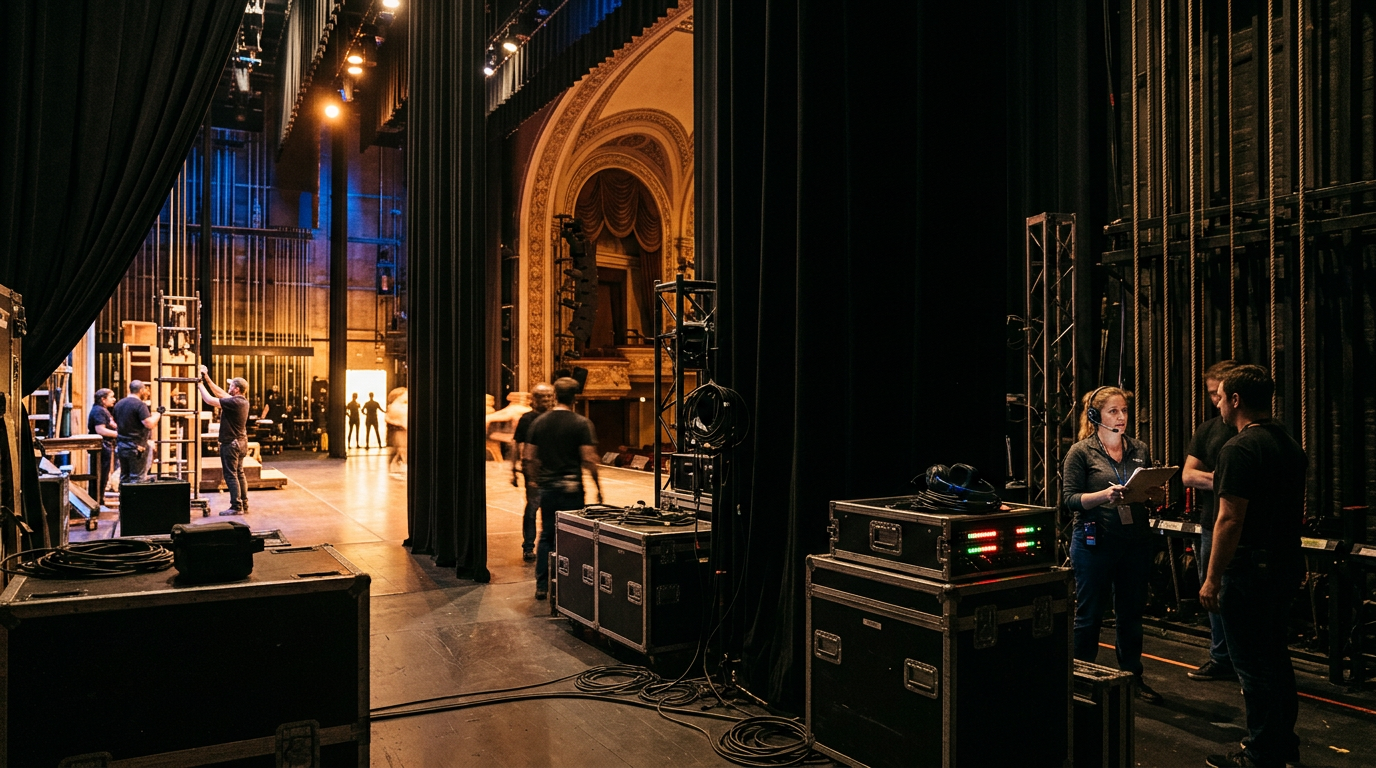
In the high-stakes environment of live entertainment, a call time is more than a schedule entry; it is a contractual mandate and a logistical foundation. When call times are managed loosely, production budgets bleed through overtime and technical rehearsals stall, yet many operations still rely on tribal knowledge rather than codified standards. This guide defines the technical nuances of call times and show calls, providing a framework for elite stage and production management.
Defining the Core Terminology
In the context of live entertainment operations, a call time is the specific moment a staff member, performer, or technician is required to be present at their assigned location and ready to work. It is not the time one arrives at the stage door or begins parking; it is the moment the "clock" starts for the purpose of payroll and operational readiness.
Call Time vs. Show Call
While often used interchangeably by laypeople, professional managers must distinguish between these two terms:
- Individual Call Time: The specific time an individual must report. For example, a lead actor may have a wig and makeup call at 6:00 PM for an 8:00 PM curtain.
- Show Call: The collective window of time during which the entire company is engaged for a performance. This typically begins with the earliest required technical preset and ends when the final "clear" is given by the Stage Manager after the performance.
- Crew Call: The time the technical team (carpentry, electrics, audio, wardrobe) begins their pre-show checks or load-in.
The Readiness Rule
The industry standard is that "on time is five minutes late." From an operational standpoint, a call time implies "ready to work." If a technician has a 09:00 call for a load-in, they should be in their work boots, with their tools tethered, and standing at the production desk at 09:00. This expectation must be communicated clearly in the onboarding process to avoid friction during high-pressure load-ins or tech weeks.
The Hierarchy of Call Types
Effective production management requires different call structures depending on the phase of the production cycle. Using a single "general call" for everyone is inefficient and expensive.
Prep and Load-in Calls
These are task-oriented. The call time is determined by the critical path of the load-in. For instance, the motors and truss must be up before the lighting team can begin hanging fixtures. Staggering these calls prevents high-rate technicians from sitting idle while waiting for structural dependencies to be met.
Rehearsal Calls
During the rehearsal phase, call times are governed by union rules (such as AEA, SAG-AFTRA, or ACTRA). Managers must account for:
- Span of Day: The total time from the first call to the final checkout.
- Rest Periods: The mandatory "turnaround" time between the end of one day’s call and the start of the next.
- Meal Breaks: Precisely timed calls that ensure the production does not incur "meal penalty" fees.
Performance Calls
These are the most rigid. A performance call is built backward from "Downbeat" or "Curtain." If the curtain is at 20:00, the Stage Manager works backward through the fight call, the vocal warm-up, the preset, and the half-hour call.
Strategic Scheduling: The "Half-Hour" and Preset
In theatrical traditions, the "Half-Hour Call" is the most significant milestone. Contrary to its name, it is not always 30 minutes before the show starts; it is 30 minutes before the commencement of the performance, which is often the point at which the house opens to the audience.
The Logic of the Half-Hour
The half-hour call serves as a legal and safety buffer. It is the final checkpoint to ensure every essential "human element" is onsite. If a performer has not signed in by the half-hour call, the Stage Manager must immediately initiate the protocol for an understudy or swing.
Technical Presets
While the cast is at half-hour, the technical crew is often already 60 to 90 minutes into their call. This time is used for:
- Dimmer Checks: Ensuring every light in the rig is functioning.
- FOH and Monitor Checks: Testing the sound reinforcement system.
- Automation Cycles: Testing moving scenery or revolves to ensure no debris has entered the tracks.
Logistics for Large Scale Operations
Managing a small ensemble is straightforward, but managing call times for large casts requires a modular approach. In residencies or touring spectacles (like Cirque or large-scale musicals), a "General Call" is a recipe for chaos in the dressing rooms and hair/makeup stations.
Staggered Call Tables
To optimize space and labor, use a staggered call system.
- Principal Call: Earliest call for complex makeup or wig applications.
- Ensemble Call: Secondary wave, often timed to a group warm-up or safety briefing.
- Full Company Call: The moment everyone must be in the building.
The "Sign-In" Protocol
The call time is legally documented via the sign-in sheet (digital or physical). In professional operations, the Stage Manager or a designated assistant monitors this sheet. If an individual is even one minute past their call time without prior communication, it is considered a "late" and may be subject to disciplinary action per the company handbook or union contract.
Decision Rules for Adjusting Calls
Production Managers often face the dilemma of whether to "push" (delay) or "pull" (advance) a call time. Use the following decision rules to maintain operational integrity:
- The 12-Hour Rule: Avoid changing a call time with less than 12 hours' notice unless it is a safety emergency. Late-night changes lead to exhaustion and increased injury risk.
- The "Dark" Opportunity: If a technical problem is discovered during pre-show, only adjust the call times for the specific departments needed to fix it. Do not bring the entire company in early, as this burns through their allotted "work hours" for the week.
- The Overtime Threshold: If an early call time will trigger "Golden Time" (double pay) later in the evening, evaluate if the task can be moved to the following morning. Professional managers must prioritize the budget over a desire for total completion in a single shift.
Communication Standards and Tools
Consistency is the enemy of confusion. Call times must be published in a central location and never communicated solely through verbal sidebars.
- The Daily Call: This is the "source of truth." It should be emailed, posted on a digital callboard, and physically taped to the stage door or company board.
- The Breakdown: A daily call should list the date, the location, the specific task, and the specific names associated with that time.
- The "Check-Back": In touring environments, the "bus call" (when the tour bus leaves for the next city) is a specialized call time. The "check-back" rule requires everyone to acknowledge receipt of a change in call time to ensure no one is left at a hotel or venue.
Using Technology
While paper remains a backup, modern entertainment operations use cloud-based scheduling software. These tools allow for real-time updates and push notifications. However, a notification is not a substitute for management. It is the Stage Manager’s responsibility to verify that the most updated call time has been acknowledged by the department heads.
Documentation and Record Keeping
Accurate call time records are essential for post-show reports and payroll processing. Every "Daily Report" or "Production Report" must include:
- Scheduled Call: The time the crew/cast was supposed to arrive.
- Actual Start: The time work actually commenced.
- Breaks: Exact start and end times for all breaks.
- Exceptions: Any late arrivals or early departures, documented with the reason.
This data allows Production Managers to analyze trends. If the wardrobe department is consistently staying 30 minutes past their checkout time, the call time for the following day should be adjusted, or the workflow must be audited for efficiency.
Where Rox Teddy fits
Rox Teddy provides specialized administrative and operational support that streamlines the communication of these critical schedules. By handling the heavy lifting of document distribution and data entry, we ensure your Stage Managers can focus on the stage rather than the spreadsheet.
Mastering the nuances of call times distinguishes a professional production from an amateur one, ensuring safety, budget compliance, and a seamless performance.