
Managing Call Times for Large Casts
Managing a large cast requires transitioning from simple schedule creation to complex logistics management. When your headcount exceeds 20 performers, a single blanket arrival t...
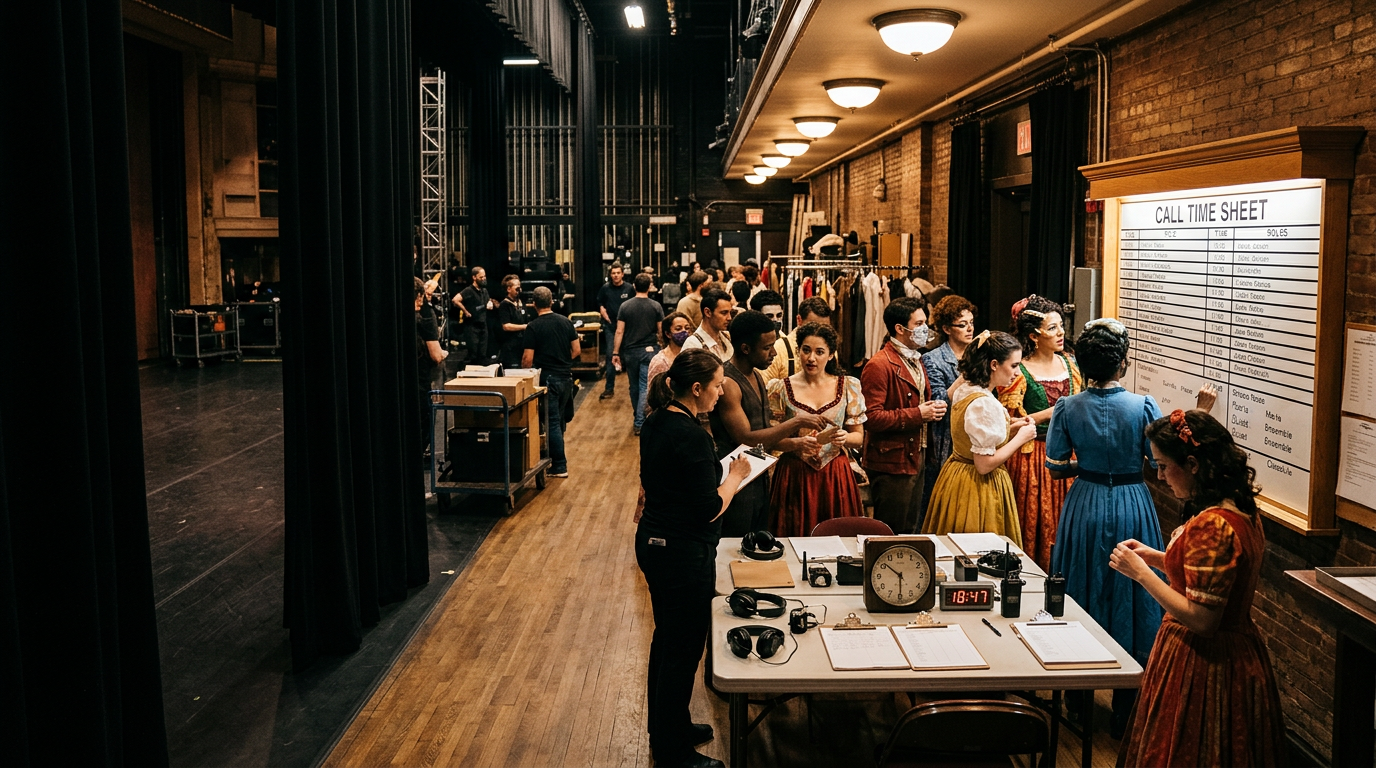
Managing a large cast requires transitioning from simple schedule creation to complex logistics management. When your headcount exceeds 20 performers, a single blanket arrival time creates bottlenecks at wardrobe, hair and makeup, and physical therapy that can delay the curtain and incur significant overtime costs.
This guide outlines specific frameworks for architecting call times that respect union regulations, maximize labor efficiency, and ensure cast readiness for high-stakes live entertainment.
The Logic of Staggered Call Times
The primary mistake in large-scale operations is treating the what a call time is as a static entry on a calendar. For large casts, the call time is a series of cascading triggers. If 40 performers arrive simultaneously, your backstage infrastructure will fail.
The Buffer Principle
Apply a 15-minute "buffer" between the arrival of various departments. If the ensemble requires extensive prosthetic makeup, their call must be decoupled from the principal cast. To determine your stagger, use this formula:
- (Total Cast Count / Number of Makeup Stations) x Service Time per Performer = Required Lead Time.
Overcoming the "Hurry Up and Wait" Syndrome
Effective managers differentiate between the "Company Call" and the "Individual Call." While the company must be in the building by a certain hour for safety briefings or focus, individual calls should be tailored to their specific track. This reduces backstage congestion and preserves the stamina of your performers, particularly in high-impact residencies or touring productions.
Building the Tiered Call Structure
To manage a cast effectively, organize your call times into three distinct tiers. This structure ensures that the most time-intensive preparations begin first without forcing the entire company to sit idle.
- Tier 1: High-Prep Performers. These are individuals requiring prosthetics, elaborate wigs, or pre-show physical therapy. Their call is typically 30 to 60 minutes ahead of the general company.
- Tier 2: The General Company. The bulk of the ensemble. Their call is timed to the start of the formal warm-up or "fight call."
- Tier 3: The "Half-Hour" Call. This is the contractual minimum for most union performers. Only those with minimal wardrobe and no pre-show specialty cues should be on this tier.
Decision Rule: The "First On, First In" Policy
If a performer is in the opening number and requires a quick change within the first ten minutes of the show, their call time must be prioritized. They cannot be stuck in the makeup chair when the "Places" call is given. Use your cue stack to reverse-engineer the arrival times: work backward from the first downbeat to ensure every "early-entry" performer is cleared through all stations 15 minutes before the house opens.
Managing Union and Regulatory Constraints
Large casts often involve multiple unions (e.g., AEA, IATSE, SAG-AFTRA) or local labor laws that dictate rest periods and "turnaround" times. Failure to manage these leads to "infringement pay" or "encroachment" penalties that can devastate a production budget.
Tracking the "Span of Day"
In many contracts, the clock starts at the first call time of the day. If you call a principal for a morning publicity appearance, their performance call time later that evening may trigger premium pay if it falls outside a 10-hour or 12-hour window.
- Actionable Rule: Never set a call time for a large cast without cross-referencing the previous night’s "Out" time. You must guarantee the 10-hour or 12-hour rest period for every individual, not just the group.
The Conflict of Photo Calls and Rehearsals
When scheduling rehearsals or photo calls prior to a performance, implement a "split call." Do not keep the entire cast on a continuous clock if you can provide a 90-minute to 2-hour unpaid break. However, ensure the "return" call time allows for a full re-warm-up period.
Communication and Distribution of the Call Sheet
A call time only matters if the performer acknowledges it. In large-scale operations, "I didn't see the email" is a common point of failure that results in late starts.
Standardizing the Daily Call Sheet Distribution SOP
Your stage management team must follow a rigorous distribution protocol to ensure 100% saturation.
- Digital Push: Send the call sheet via a dedicated production management app or SMS group.
- Physical Posting: Post the sheet at the stage door and in the green room.
- The "Call-In" Line: For touring shows, a recorded voicemail line with the next day's call times is an essential redundancy.
The 12-Hour Rule for Changes
Changes to the call time should be finalized and distributed no later than 12 hours before the first call of the following day. For evening performances, the "Final Call" should be out by the end of the previous night's show. If the call time moves earlier than previously scheduled, you must receive a direct confirmation (not just an "o-k" via text) from every affected cast member.
Specialized Calls: Fight, Lift, and Aerial
In spectacle-driven live entertainment, call times must account for "Safety Calls." These are non-negotiable windows where the cast must mark dangerous choreography on stage.
The "Stage Space" Hierarchy
Large casts cannot all use the stage for warming up at once. Your schedule should reflect a hierarchy:
- 0:00 - 0:15: Aerial Rigging Check (Clear Stage).
- 0:15 - 0:45: Fight Call (Full Cast involved in combat).
- 0:45 - 1:00: Dance Captain Re-spacing (Ensemble only).
- 1:00 - 1:15: Vocal Warm-up (Green Room).
By staggering these calls, you ensure that the Stage Management team can focus on the specific safety requirements of each group without the distraction of 50 people milling about the wings.
Integrating Technical and Wardrobe Requirements
The wardrobe department is the most frequent victim of poorly managed call times. If you have 60 performers and 6 dressers, you cannot have a 20-minute window for everyone to get into costume.
The Wardrobe Loading Schedule
Create a "Wardrobe Priority List" based on the complexity of the costume.
- Category A: Heavy armor, wired garments, or corsetry. These performers have the earliest call.
- Category B: Standard suiting or street wear.
- Category C: Performers who remain in their "preset" costume for the first 30 minutes of the show.
Hair and Makeup (HMU) Flow
In large-scale residencies, use a "Slotting System." Instead of a general call, every performer is assigned a 15-minute window for hair and makeup. If a performer misses their slot, they move to the end of the line, risking a "late to places" disciplinary notice. This creates personal accountability and prevents the 15-minute pre-show rush that leads to low-quality work and stressed technicians.
Handling Late Arrivals and Emergencies
Despite your best planning, large casts will experience "no-calls" or late arrivals. Your call time strategy must include a "Swing and Understudy" protocol.
The Understudy Check-In
Understudies and swings should have a call time identical to or 15 minutes earlier than the principals they cover. This ensures that if a principal hasn't checked in by their designated time, the understudy is already present and beginning their prep.
The "Hard Mark" for Replacement
Establish a "Hard Mark" — a specific time (usually 45 minutes before curtain) where, if a performer is not in the building, the swing is officially put into the show. Once the "Hard Mark" passes, the principal is not allowed to perform even if they arrive two minutes later. This rule prevents last-minute confusion regarding who is on stage and ensures the technical team knows exactly which presets to prepare.
Where Rox Teddy Fits
Rox Teddy provides technical directors and production managers with specialized logistics support to handle the complexities of large-scale cast movements. Our team can help you audit your current scheduling SOPs and implement digital communication tools that ensure your call times are accurate and confirmed.
Efficient call time management is the difference between a chaotic backstage and a professional, disciplined production.