
Backstage Credential Levels Explained
Managing backstage access in highstakes environments is a balancing act between operational efficiency and uncompromising security protocols. Without a tiered credentialing syst...
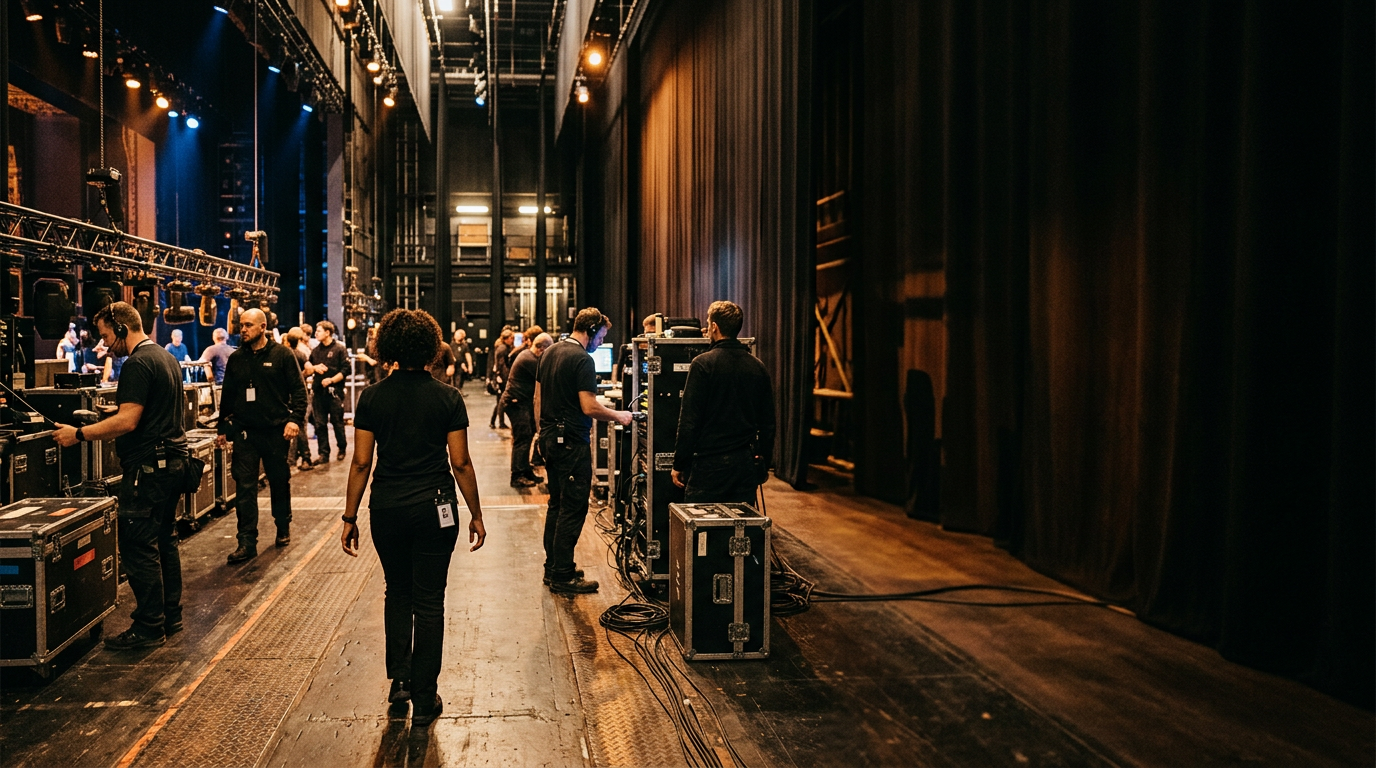
Managing backstage access in high-stakes environments is a balancing act between operational efficiency and uncompromising security protocols. Without a tiered credentialing system, production leads risk overcrowding critical work zones, compromising artist privacy, and creating safety hazards during high-risk load-ins. This guide provides a definitive framework for structuring backstage credential levels to ensure the right people are in the right places at the right times.
The Logic of Tiered Access
An effective credential system is built on the principle of "least privilege." This means personnel are granted the minimum level of access necessary to perform their specific job function. In live entertainment operations, credentials serve three primary purposes: identification, authorization, and safety management.
When designing your levels, avoid the common mistake of granting "All Access" to every member of the touring party or venue staff. Excessive access dilutes the security perimeter and makes it impossible to manage density in sensitive areas like the "V" (the immediate wings of the stage) or the star dressing room corridor.
Level management typically follows a hierarchical structure, but it must also include lateral zones. For example, a Caterer and a Lighting Tech may both have credentials, but their physical access path should never overlap in the same work zones.
Defining the Standard Access Tiers
To maintain control over a venue, you must categorize your credentials into distinct tiers. While nomenclature varies by production, the following four-tier system represents the industry standard for large-scale operations.
Tier 1: All Access (AA)
This is the highest level of clearance. Holders of AA credentials are permitted in every guest-facing and production-facing area of the venue, including the stage, dressing rooms, production offices, and the front of house.
- Who gets it: Tour Manager, Production Manager, Lead Stage Manager, Head of Security, and the Principal Artist(s).
- Decision Rule: If the individual does not have a direct, emergency-level decision-making role across both the business and technical facets of the show, they do not need All Access.
Tier 2: Production & Technical
This tier is for the working crew. These individuals need access to the stage, the pit, the loading dock, and technical galleries, but they generally do not need access to the VIP lounge or the artist’s private dressing room suite.
- Who gets it: Backline techs, lighting/audio engineers, house heads, and local union crew.
- Decision Rule: Access is limited to active work hours. Unlike Tier 1, these credentials may be revoked or restricted during the actual performance window to keep the wings clear for talent.
Tier 3: Talent & Management
This level focuses on the "clean" side of the backstage area. It provides access to dressing rooms, catering, and the green room, but limits access to high-risk technical areas like the fly floor or the electrical sub-station.
- Who gets it: Support acts, background dancers, wardrobe assistants, and company management.
- Decision Rule: Ensure these credentials allow for "front-to-back" movement so talent can move from the dressing room to the stage without needing a security escort.
Tier 4: Limited / Guest
These are temporary credentials, often referred to as "After Show" or "Working Guest" passes. They are highly restricted in both location and duration.
- Who gets it: High-level VIPs, record label executives, or visiting press.
- Decision Rule: Guest passes should never grant access to the stage or the immediate wings. Access should be restricted to a designated "Guest Zone" and have a clear expiration (e.g., valid only for 30 minutes post-show).
Zone-Based Zoning and Spatial Security
A credential is only as good as the physical zones it corresponds to. To implement this effectively, you must map your venue into color-coded or numbered zones.
- Zone A (The Stage & Wings): The most restricted area. Only those essential to the immediate running of the show should be here during the performance.
- Zone B (Production Offices): Restricted to administrative and management staff.
- Zone C (The Loading Dock): High-risk area during load-in/load-out. Restricted to technical crew and logistics coordinators.
- Zone D (Artist Corridor): Dressing rooms and green rooms. High-privacy area.
By printing these zones directly on the credential (e.g., a badge that lists "Zones: A, B, D"), security personnel can instantly identify if a person is out of place. This is a core component of backstage access best practices for professional touring environments.
Designing Functional Credential Hardware
The physical design of the credential is just as important as the data it represents. In the high-intensity environment of a darkened backstage, a credential must be legible from ten feet away under blue-light conditions.
Visual Cues
Use high-contrast color coding for different tiers. For example, red may signify "All Access," while yellow signifies "Catering/Support." Avoid using subtle shades or intricate patterns that can be easily forged or misidentified by a security guard at a busy checkpoint.
Security Features
To prevent unauthorized duplication, professional productions utilize several anti-counterfeit measures:
- Holographic Overlays: Difficult to replicate with standard printers.
- Serial Numbers: Every badge is assigned to a specific person in a master log. If a badge is lost, that specific number is "burned" (voided).
- Photo ID: In long-term residencies or high-security tours, credentials should include a headshot of the bearer.
- RFID/NFC Integration: This is the gold standard. Scannable chips allow for real-time tracking of who is in the building and can automatically lock or unlock electronic doors based on access level.
Handling Special Access Scenarios
Not every person on-site fits into a neat category. Your operations plan must account for these outliers without compromising the integrity of the system.
The "Runner" Problem
Local runners need access to almost everywhere (production office, catering, the loading dock) but they are often temporary hires. Solve this by issuing a specific "Runner" laminate that is checked out at the start of the day and returned to the Production Manager during the "out." Never give a runner a permanent tour laminate.
Press and Media
Media access should be strictly timed and escorted. A "Press" credential should only grant access to the Front of House (FOH) "soundboard" area for the first three songs of a performance. Once the designated "photo-op" ends, the credential should no longer be valid for backstage entry.
Emergency Personnel
Fire marshals and paramedics must have unimpeded access to the entire venue. However, they should be briefed on the production’s specific flow to ensure they do not inadvertently create a safety hazard on stage. Many venues provide "House Security" badges that override all other zone restrictions for these individuals.
Implementation: The Checkpoint Strategy
A credential system is only effective if it is enforced. This requires a strategic placement of security personnel and scanning stations.
- The Stage Door: This is the primary "hard" checkpoint. No one enters from the street without a credential or being on the daily "approved" list.
- The "V" / Wing Entry: This is the secondary "soft" checkpoint. Security here ensures that even people with "Talent" credentials do not enter the wings if they aren't part of the current scene.
- Crossover Points: Any area where the public-facing "Front of House" meets the "Back of House" must be heavily monitored.
Stage managers should conduct a "security sweep" 30 minutes before house-open to ensure everyone in the wings is wearing a visible, valid credential. Anyone without one should be directed to the Production Office immediately, regardless of their claims of "knowing the artist."
Managing the Credential Lifecycle
Credentialing is not a "set it and forget it" task. It requires active management from the moment a tour is announced until the final truck is loaded.
- Pre-Production: Collect names and photos for all touring staff and permanent venue employees three weeks before the first date.
- Distribution: Hand out credentials individually. Do not leave a "stack" of badges on a desk for people to grab. This ensures every badge is accounted for and linked to a person.
- The "Burn" List: If a crew member is fired or a guest pass is lost, security teams must be alerted immediately. If using RFID, the badge is deactivated in the software. If using laminates, the security guards must be given a "VOID" list with the badge number.
- Post-Show: Collect all guest and temporary passes. These should be destroyed or marked "Invalid" to prevent them from being reused at a future date or different venue.
By maintaining a strict lifecycle, you reduce the "badge creep" that often happens halfway through a tour, where unauthorized people gradually gain access to restricted zones through familiarity with the staff.
Where Rox Teddy fits
The Rox Teddy platform streamlines the administrative burden of credential management by centralizing personnel data and access permissions. It allows production managers to assign tiers, track distribution, and sync security lists in a single, secure interface. This ensures that the physical security on the ground is always backed by accurate, real-time data.
Effective backstage management is about creating an environment where the production can run without friction or threat. By implementing these credential levels, you protect your talent, your crew, and the integrity of the performance.