
No-Show Risk Reduction Checklist
Noshows in live entertainment are more than a logistical headache; they are a direct threat to the show's financial viability and the safety of the remaining cast. This checklis...
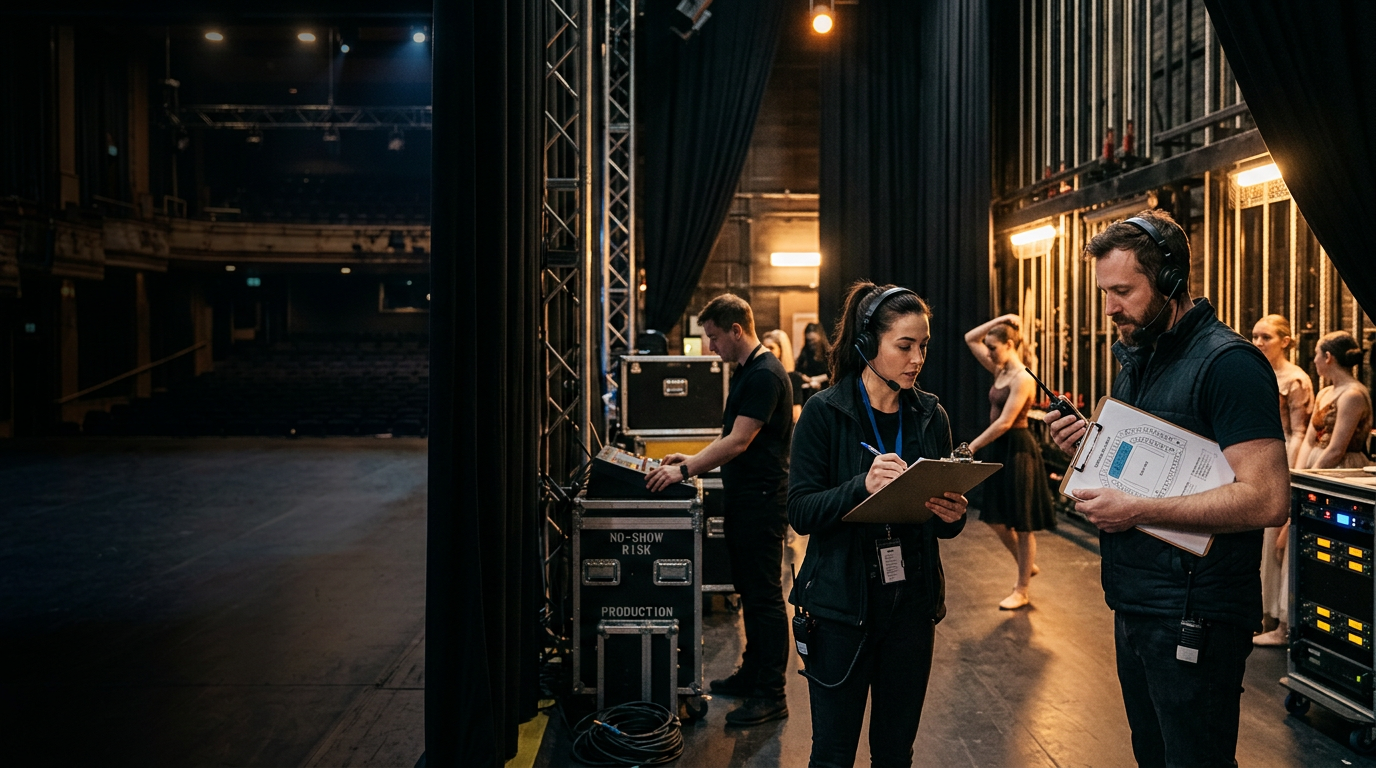
No-shows in live entertainment are more than a logistical headache; they are a direct threat to the show's financial viability and the safety of the remaining cast. This checklist provides a systematic framework for hardening your operations to ensure performer reliability and minimize the risk of a dark stage.
Institutionalize the "Check-In" Culture
A performer who feels invisible is more likely to miss a call. Reliability starts with a standardized, non-negotiable check-in process that moves beyond a physical sign-in sheet on a clipboard.
The Digital Callboard
Physical sign-in sheets are prone to "ghost signing" and require a stage manager to be physically present at the board to verify attendance. Transition to a digital check-in system that timestamps entries. This provides real-time data to production management and creates a high-accountability environment.
The 30-Minute Threshold
Establish a hard rule: if a performer is not checked in 30 minutes prior to their call time, they are considered a potential no-show.
- 30 Minutes Prior: Stage management initiates a "Wellness Check" via text or phone.
- 20 Minutes Prior: The Company Manager is alerted to check local housing or transit routes.
- 15 Minutes Prior: The decision is made to pull the performer and initiate the last-minute swing substitutions SOP.
Precision in Performer Availability Tracking
No-shows often stem from administrative failures—specifically, miscommunications regarding approved time off or external gigs. You cannot prevent a no-show if your master schedule is inaccurate.
Centralized Leave Management
Stop accepting time-off requests via text, email, or verbal "hallway" agreements. Use a centralized platform for performer availability tracking. When a performer can see their "Approved" status in a shared system, the likelihood of a "thought I was off" excuse drops to zero.
Blackout Dates and Contractual Teeth
Clearly define "Performance Critical" dates in the initial contract. This includes opening nights, filming dates, and high-revenue holiday blocks. Link attendance to performance bonuses or "loyalty stipends" paid out at the end of a run. While negative reinforcement (fines) has its place, positive incentives for 100% quarterly attendance are often more effective at fostering a culture of reliability.
Transit and Logistics Hardening
For touring shows or residencies in high-traffic urban centers (like New York, London, or Las Vegas), transit is the primary "valid" excuse for a no-show. A professional operation removes this variable from the performer’s hands.
The Radius Rule
For local hires, implement a "Commute Contingency" policy. Performers living outside a specific radius must provide a secondary transit plan (e.g., a specific train line or carpool buddy).
Management-Provided Transport
For touring companies, the most effective way to eliminate no-shows is the "Company Bus" model. If the bus departs at 4:00 PM, and everyone is on it, the risk is mitigated. If you rely on "Own Arrangement" travel, you must require performers to share their GPS location or "Arrived at Hotel" status via a company app at least four hours before the half-hour call.
The Health and Wellness Safety Net
Authentic emergencies happen. A no-show is often the result of a performer feeling they cannot "call out" legally, leading to a panicked disappearance at the last minute.
The "No-Penalty" Early Notification
Create a window—typically 4 to 6 hours before the show—where a performer can call out for illness without a disciplinary "strike," provided they speak directly to the Company Manager. This window allows you to execute your swing or understudy plan with composure rather than in a state of chaos.
Mental Health and Burnout Monitoring
In long-running residencies or grueling tours, attendance starts to slip due to burnout. Stage managers should track "micro-behaviors":
- Increased tardiness (even by 2–3 minutes).
- Withdrawal from company social areas.
- Decline in "marking" during rehearsals. These are leading indicators of an impending no-show. Addressing these through a scheduled "personal day" is cheaper than a dark stage or a last-minute scramble.
Rigorous Understudy and Swing Readiness
A no-show only becomes a "crisis" when the backup system fails. Reliability isn't just about the person who was supposed to be there; it is about the person who replaces them.
Validating the "Swing Chain"
Every role must have a primary and secondary cover. On any given night, the Stage Manager must verify that the cover is not only in the building but is physically and mentally capable of performing.
- The "Half-Hour" Cover Check: At the 30-minute call, the Stage Manager should receive a verbal or digital "Ready" status from all swings and understudies.
- Split-Track Drills: Periodically run rehearsals where a swing has to jump in mid-scene. This builds the "muscle memory" needed to handle valid no-shows without stopping the show.
Emergency Notification Escalation
In the event of a confirmed no-show, the communication chain must be instantaneous.
- Source: Performer is missing at the 30-minute mark.
- Action 1: SM triggers the last-minute swing substitutions SOP.
- Action 2: Wardrobe is alerted to pull backup costumes.
- Action 3: Sound/A2 is alerted to swap wireless mics and adjust EQ presets for the replacement performer.
- Action 4: Producer/House Manager is alerted if the cast change requires a program insert or an announcement.
Auditing the Production Culture
Sometimes, the "no-show" problem is systemic. If a production treats its cast as expendable assets rather than professional partners, reliability will suffer.
The Post-Mortem of Every Absence
When a no-show occurs, do not just discipline and move on. Conduct a "Root Cause Analysis" (RCA):
- Was the call time communicated clearly?
- Was the performer struggling with a known personal or health issue?
- Did the digital scheduling system fail to show an update?
- Is there a conflict within the cast that makes the performer want to avoid the workplace?
Professionalism as a Two-Way Street
Reliability is a reflection of leadership. If rehearsals consistently start late, or if schedules are posted 24 hours before the work week begins, the production team is signaling that time is not valuable. A high-reliability cast is almost always the result of a high-precision management team.
Ensure that your performer availability tracking is updated in real-time and accessible to the cast. Transparency reduces anxiety, and reduced anxiety leads to better attendance.
Where Rox Teddy fits
Rox Teddy simplifies the complexities of cast management by providing a centralized hub for scheduling, communications, and real-time check-ins. It eliminates the friction of manual tracking, ensuring that stage managers and producers have the data they need to anticipate absences before they become emergencies.
Reliability is not a personality trait of your cast; it is a measurable outcome of your operational discipline.