
Production Scheduling for Live Entertainment
Effective production scheduling is the difference between a highcaliber performance and an operational collapse that creates burnout, safety risks, and budget overruns. In the f...
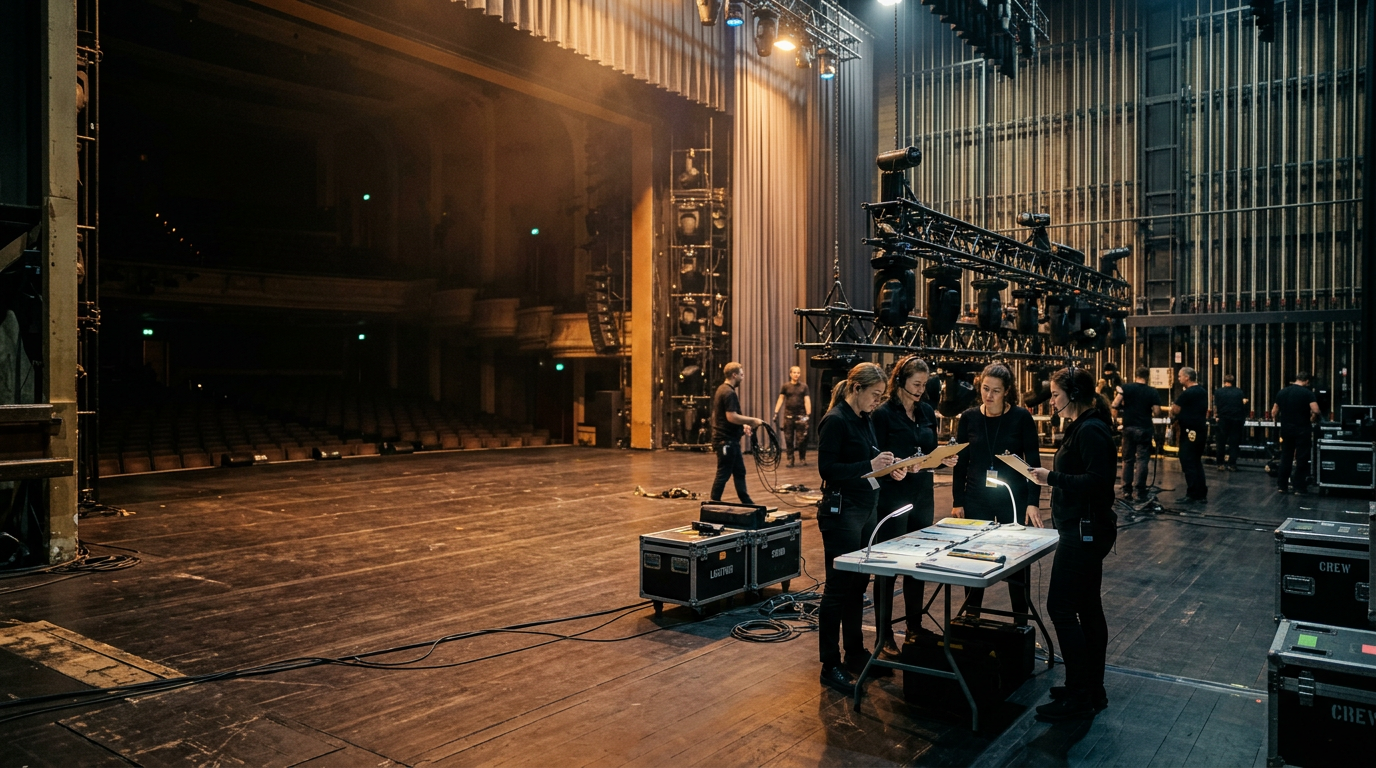
Effective production scheduling is the difference between a high-caliber performance and an operational collapse that creates burnout, safety risks, and budget overruns. In the fast-paced world of live entertainment, a schedule is not a static document; it is a tactical roadmap that must account for labor laws, technical tolerances, and human endurance. This guide provides the frameworks necessary for production managers to build resilient schedules that protect the vision of the show while maintaining operational integrity.
The Hierarchy of Scheduling: Macro to Micro
Successful live entertainment scheduling requires three distinct layers of planning. If you jump straight into daily call sheets without a season or tour master, you will inevitably hit resource bottlenecks.
1. The Master Production Schedule (MPS)
The MPS covers the entire lifecycle of a production, from load-in and tech rehearsals to closing night and strike. This is where you identify high-level conflicts, such as overlapping use of rehearsal studios or the integration of freight arrivals with stage availability.
2. The Weekly Performance Schedule
This is the rhythm of the show. It dictates the 8-show week, dark days, and maintenance windows. For touring productions, this includes travel days and "day-of-show" load-ins, which are the most volatile periods in production scheduling.
3. The Daily Call Sheet
The final level is the daily schedule. This document must be granular, often broken down into 15-minute increments for the stage management team. It details exactly who is on stage, which departments are working (audio, LX, flys), and the specific rehearsal or maintenance goals for that block of time.
Coordinating Technical and Talent Requirements
A common mistake in production scheduling is treating the "on-stage" time for tech and the "on-stage" time for performers as a single block. These must be decoupled to maximize efficiency.
When coordinating large performer casts, the schedule must account for "staggered calls." Calling 40 dancers at 9:00 AM for a lighting focus session where they aren't needed until 11:00 AM is a waste of payroll and morale. Instead, schedule "Dry Tech" hours where the crew works through cues without performers, followed by "Sitzprobe" or "Piano Tech" where the cast joins the process.
Decision Rule: The 2-Hour Buffer. In any new production or residency, always schedule a two-hour "safety window" between the end of technical rehearsals and the start of a public preview. This allows the crew to reset the stage, address critical safety notes, and gives the cast time for a proper meal break—avoiding the "penalty rates" often mandated by union contracts (like AEA or IATSE) when breaks are truncated.
Managing Capacity and Availability
In live entertainment, you are constantly juggling the availability of specialists who may be working across multiple shows. This is where the concept of holds and releases becomes central to your workflow.
When scheduling guest designers or specialty acts, you will often place a "hold" on their time weeks or months in advance. As the production schedule firms up, you must have a clear internal deadline for when these holds are either "firmed" (contracted) or "released." Failing to manage this process leads to "ghost scheduling," where you believe you have a full crew until three days before load-in, only to find your lead rigger has taken a different gig because their hold wasn't challenged.
Critical Milestones for Availability:
- The 48-Hour Challenge: If a contractor is on a "Second Hold," you must be prepared to challenge the First Hold at least 48 hours before work begins.
- The Travel Window: For touring shows, travel days must be scheduled with a 20% "contingency margin." If a drive is estimated at 8 hours, the production schedule should not call for a load-in start until 11 hours after the bus departs.
Labor Laws and Union Compliance
Production scheduling is not just about time; it is about the cost of time. In the US, Canada, and the UK, various unions (AEA, IATSE, SAG-AFTRA, Equity) dictate the maximum duration of a "call" and the minimum "turnaround" time between calls.
The "Turnaround" Rule
Most professional contracts require a 10-to-12-hour rest period between the end of one shift and the start of the next. If you end a tech rehearsal at midnight, your crew cannot legally (or safely) return until 10:00 AM or noon the next day without the production incurring massive "infringement pay" or "encroachment" penalties.
Meal Breaks and "Grace" Periods
Standard practice is a meal break every five hours. While some contracts allow for a 30-minute "grace period" to finish a specific scene or lighting look, abusing this will lead to grievances and a breakdown in the relationship between management and the crew. Always schedule 60 to 90 minutes for meals to allow for off-site egress, especially in remote venues or themed entertainment environments.
Maintenance and "Dark" Time Integration
The most neglected aspect of event scheduling is maintenance. In a long-running residency or a rigorous touring schedule, gear breaks and costumes degrade.
The Maintenance Ladder:
- Weekly Audio/LX Check: 2 hours per week, usually on the first day of the performance week.
- Pyrotechnic/Special Effects Safety Drill: 1 hour per month.
- Understudy and Swing Rehearsals: 3–5 hours per week. These must be scheduled during "daytime" hours, requiring a separate stage manager and audio lead call, often on the second or third show day.
If these sessions are not hard-coded into the master schedule from day one, they will be discarded when things get busy. This leads to "technical debt," where the show’s quality slowly erodes until a major failure occurs mid-performance.
Effective Communication of the Schedule
A schedule is only useful if it is accessible and understood. In the modern production environment, paper call sheets are backup, not the primary source.
- Version Control: Always use a date-time stamp in the footer (e.g., 2023-11-01_v4). Never name a file "Final Schedule."
- The "Push" Method: Use digital platforms to push updates to the cast and crew. If a call time changes by more than 30 minutes, a manual notification (SMS or email) is required to ensure the change was seen.
- Visibility Tiers: Create filtered views. The band doesn't need to see the costume shop's sewing schedule, and the rigging crew doesn't need to see the lead actor's press junket. Overloading staff with irrelevant data leads to them ignoring the schedule altogether.
Avoiding "The Tech Slump"
"The Tech Slump" happens roughly 72 hours into a technical rehearsal period. Concentration drops, and the risk of injury increases. To combat this through scheduling:
- Avoid the 12-out-of-12: While 12-hour workdays are common in theatre tech, they are rarely productive in the final four hours. If the budget allows, break these into two shifts or limit them to no more than two consecutive days.
- Schedule "Quiet Time": Give the director and designers 30 minutes of "quiet time" on stage before the cast arrives. This allows them to confer without the pressure of a 50-person cast watching them, leading to faster decision-making once the clock is running.
Conclusion
Production scheduling for live entertainment is a balancing act between the needs of the creative team and the physical and legal limits of the human beings executing the work. By building a master hierarchy, respecting union turnarounds, and accounting for maintenance from the start, you create an environment where the show can actually succeed. Professional scheduling is not just about filling slots on a calendar; it is about the strategic allocation of energy.
Where Rox Teddy fits
Rox Teddy provides a centralized platform for managing these complex timelines, ensuring that all stakeholders have real-time access to the most current call sheets and production milestones. The system simplifies the management of performer availability and technical schedules to help teams avoid the common pitfalls of double-booking and union infringements.
Mastering your production schedule ensures that when the curtain rises, the only drama on stage is the kind you actually rehearsed.