
Using AI to Schedule Performers with Fair Booking Distribution
AI-assisted scheduling can finally solve the oldest problem in live entertainment: how to staff every performance with the right talent without quietly favoring the same handful of performers week after week. This guide breaks down how Rox Teddy uses multi-factor scoring, swing prioritization, and refinement loops to keep bookings fair, transparent, and defensible.
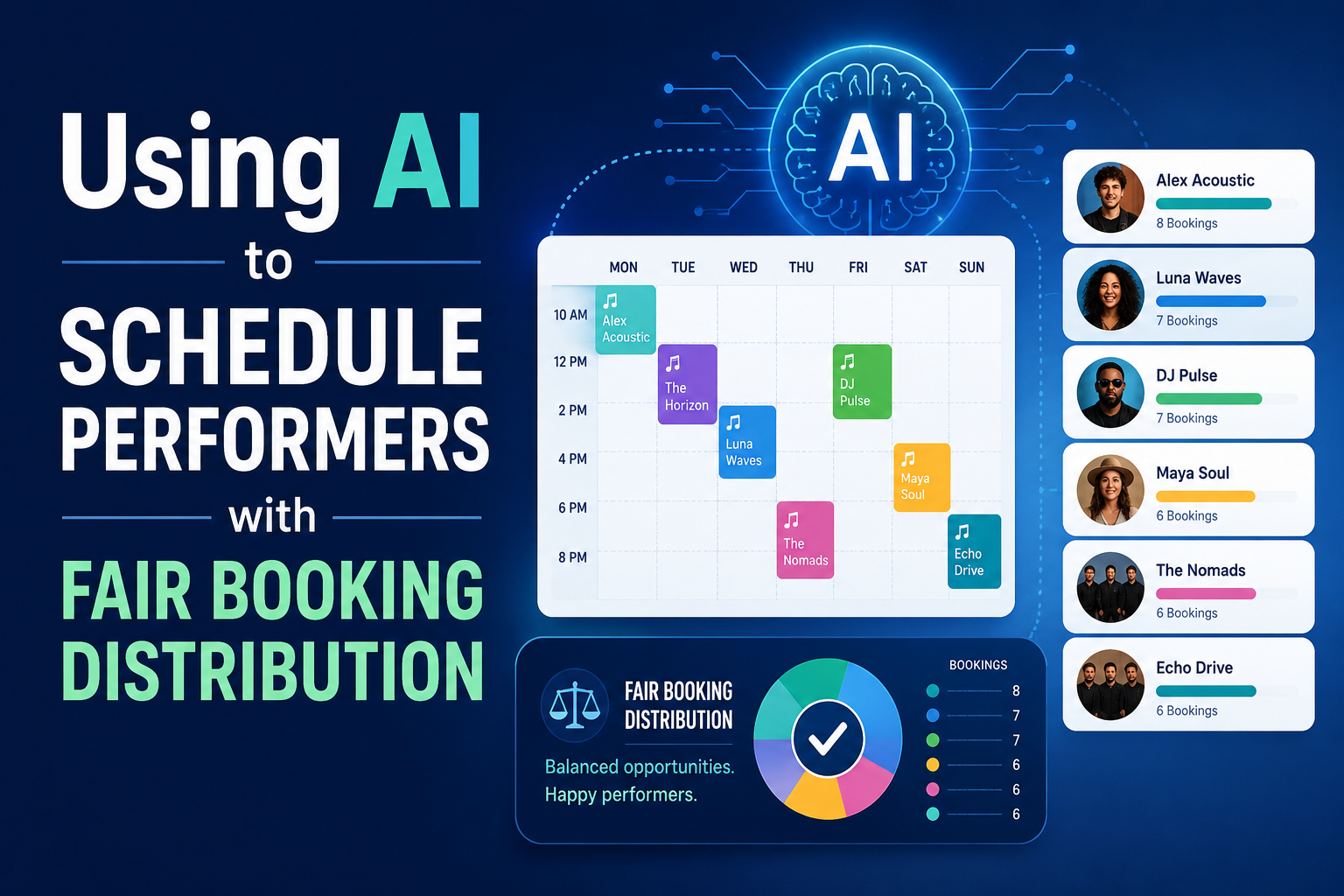
Why fair distribution matters
In live entertainment, "who gets booked" is never just a logistics question. It is a compensation question, a morale question, and increasingly a compliance question. When the same three performers absorb 80% of the high-paying gigs, the rest of your roster disengages, churn rises, and you end up scrambling for swings on the nights that matter most.
Manual scheduling almost always drifts toward favoritism, even when the booker has the best intentions. Familiar names get reached for first. Performers who replied quickly last week get rewarded this week. Swings get treated as a last resort instead of an investment.
AI-assisted scheduling fixes this by turning "who is the right person for this slot" into a transparent, multi-factor calculation that you can audit and tune.
What a fair AI scheduler actually evaluates
A good auto-assignment engine should weigh, at minimum:
- Skillset match — does the performer hold every required skillset for the role?
- Availability — confirmed available for the date, not just "not blocked"?
- Recent booking volume — how many shifts has this performer worked in the last 14 / 30 / 90 days?
- Earnings balance — are paid hours and fees distributed evenly across eligible performers?
- Reliability score — historical on-time check-ins, no-shows, and cancellations
- Swing status — primary performers should be prioritized before swings
- Venue familiarity — has the performer worked this venue before?
- Minimum-days-ahead and block-booked-dates — respect performer-set guardrails
Rox Teddy combines these into a single score per (performer, role) pair, then assigns greedily across the schedule while respecting one-per-show, one-per-day, and skillset-required constraints. Swings receive a -50 penalty so they are only used after every qualified primary has been considered.
The fairness layer: rotating opportunity
Scoring alone is not fairness. A performer with a perfect reliability record will always win head-to-head against a newer hire if you only score competence. The fairness layer is what prevents that.
In Rox Teddy, fairness is enforced two ways:
- Recent-bookings penalty. Each shift a performer has worked in the trailing window reduces their score for new offers, so the system spreads work across the roster instead of stacking it on the same names.
- Workload balancing. A configurable per-performer weekly cap and a balance-workload option steer assignments away from anyone already near their limit.
The result is a roster where opportunity rotates naturally, without you having to keep a private spreadsheet of "who got the last good one."
How auto-assign actually runs in Rox Teddy
Auto-assign is preview-first by default. Nothing is written to the schedule until you review and confirm. The flow is:
- Scope the run. Choose all upcoming events, a specific set of venues, a date range, a list of individual events, or a date-range-plus-venue combination. Optionally narrow further to only unstaffed or partially-staffed events, and restrict to specific skillsets.
- Set the rules. Toggle "respect availability," "balance workload," and "strict primary preference" (so swings are only used when no primaries are available). Set a max-per-week cap per performer.
- Preview proposals. The engine returns a per-event, per-role proposal with the chosen performer, their score, and the reasons behind it. For single-event runs it also returns ranked alternatives so you can swap any assignment before applying.
- Optionally refine with AI. Run a refinement pass that re-examines the proposals and suggests swaps — for example, to improve fairness, reduce swing usage, or honor a soft preference you describe in plain language. Refinement output is itself a proposal, never a silent write.
- Apply. Once you accept, the assignments are written in a single batch. You are then prompted to send a bulk assignment notification to the affected performers — sending is admin-initiated and optional.
- Undo if needed. Every auto-assign run is recorded and can be reverted from the Undo dialog, which restores the prior assignment state.
This preview-refine-apply-undo loop is the entire safety story. Auto-assign never bypasses your judgment; it just removes the manual labor of finding the best candidate for each slot.
What to measure
Three numbers tell you whether AI scheduling is actually working:
- Spread of paid hours across active performers. The gap between your most-booked and least-booked eligible performers should shrink month over month.
- Swing utilization rate. Should fall as auto-assign learns your roster and primaries get matched first.
- Performer satisfaction. Survey quarterly. If it does not rise, your weights are wrong.
Fair scheduling is no longer a values statement — it is an engineering problem with a measurable answer. The teams that treat it that way keep their best performers longer and spend their booker's time on the work that actually requires judgment.